

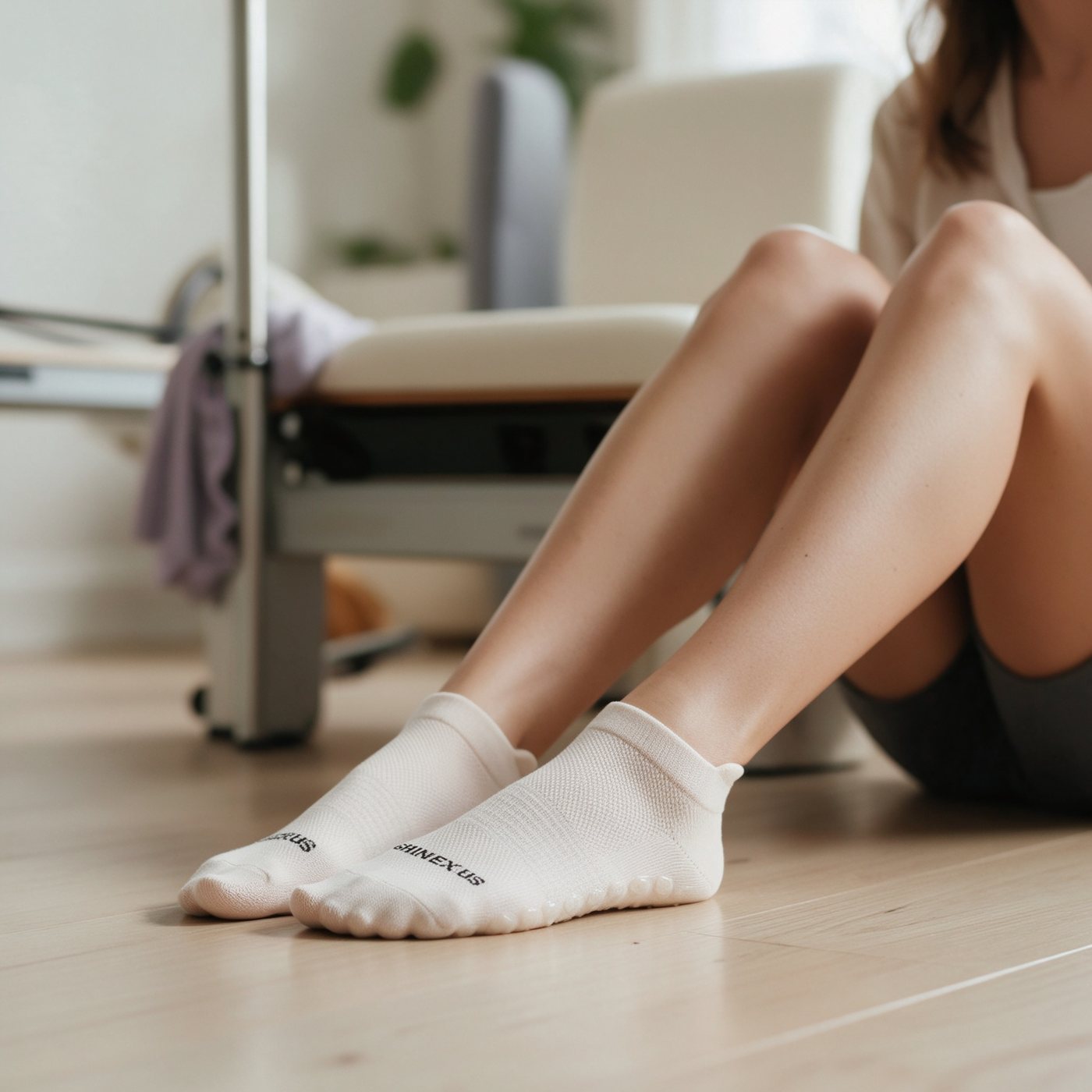
The same pair of grip socks can feel completely different depending on what you are standing on. A mat, a reformer footplate and a polished wooden studio floor each respond to the sole in their own way. Understanding those differences makes it easier to choose a pair that works across your week.
Why the surface matters
Grip socks are not a single product category. The sole is designed to do a job, and that job changes with the floor beneath it. On a foam mat, the goal is usually to stop the feet sliding forward in a lunge or backward in a plank. On a reformer, the goal is to keep a small contact point — the ball of the foot against a footbar — stable under load. On a wooden studio floor, the goal is a sense of being planted rather than skidding.
None of these outcomes depend on grip alone. They also depend on how the sock fits, how much fabric sits between the foot and the floor, and how much moisture builds up during class. A sock that is too loose will twist regardless of how much grip it carries, and a very thick sock can dull the feedback you get from a footplate.
On a mat
Mats are the most forgiving surface. Foam compresses slightly under the foot, so contact is broader and the sole has more to work with. In a mat class you will usually notice grip most in downward-facing movements, side planks and anything where one foot presses and the other lifts.
The complication on a mat is sweat. Moisture sits on the surface of the mat rather than dispersing, particularly in a warm room. A cotton-rich sock absorbs some of it, which keeps the sole in closer contact for longer. It also means the sock itself gets damp, so a spare pair in your bag is a sensible habit rather than an indulgence.
If you practise at home, the mat matters as much as the sock. A worn mat with a shiny top layer can slide on a smooth floor underneath, and no sock will fix that. A thin, textured mat over a wooden floor tends to behave better than a thick, soft one that bunches at the edges.

On the reformer
Reformer work concentrates force into small areas. The ball of the foot on a footbar, the heel against a footplate, the arch under a strap. Grip here is less about the whole sole and more about whether the part of the foot in contact stays where you placed it.
Two details matter more than most people expect. The first is heel fit. If the heel of the sock is loose, the foot can rotate inside it when you press, and the grip pattern shifts away from the contact point. The second is how much fabric sits under the ball of the foot. A smooth, dense sole gives a more predictable press than a soft, thick one.
Technique still leads. A footbar press works because the ankle, knee and hip are aligned; a sock cannot compensate for a collapsing arch or a foot placed too high on the bar. Where a good grip sock helps is in the small margins — the difference between a press that feels secure and one that feels like it is quietly drifting.
If reformer classes are most of your week, it is worth choosing a pair with a fitted heel and an arch that follows the foot rather than cutting across it. Our ankle grip socks are built with a midfoot support structure for exactly this kind of work, and the reformer guide covers style choices in more detail.
Wooden and laminate floors
Many UK studios are finished in light wood or laminate, which looks beautiful and behaves quite differently from a mat. These floors are smooth and slightly reflective, and dust or polish can make a difference from one day to the next. Socks feel more slippery on a freshly cleaned floor than on one that has been walked on all morning.
This is the surface where a dense grip sole is most noticeable. It is also where bare feet feel least secure, which is one reason so many studios ask clients to wear socks rather than practise barefoot. If you are transitioning from mat work to standing work — barre, standing Pilates, or the standing series in a reformer class — a wooden floor is where you will feel the change most.
A practical note: wooden floors are also less forgiving on the sock itself. The grip sole is in direct contact with a hard surface, so avoid walking outside in the same pair. Grit between the dots and the floor wears the pattern faster than class time does.
Carpet and home set-ups
Carpet is the odd one out. It offers plenty of friction, so sliding is rarely the issue. The problem is usually the opposite: too much drag, which can pull a loose sock around the foot during transitions. If you practise on carpet at home, fit becomes more important than grip density.
If you use a mat over carpet, check that the mat itself does not ripple. A curling corner is a trip hazard regardless of what you are wearing, and it is worth replacing a mat that will not lie flat before spending more on socks.
Surfaces at a glance
| Surface | What grip is doing | What to prioritise |
|---|---|---|
| Foam mat | Holding position in lunges, planks and side work | Breathable fabric, a spare pair for warm rooms |
| Reformer footbar | Keeping a small contact point stable under load | Fitted heel, dense sole, arch that follows the foot |
| Wooden or laminate | Feeling planted in standing and barre work | Dense grip pattern, snug fit, no outdoor wear |
| Carpet | Resisting drag rather than sliding | Close fit, smooth sole rather than deep tread |
What to look for in a pair that works across surfaces
If you want one pair for the whole week, look for three things. A fitted heel, so the sock stays where you put it. A sole with a dense, even pattern rather than a few large shapes. And a fabric that feels soft but not fluffy — something with enough cotton to breathe and enough stretch to stay close.
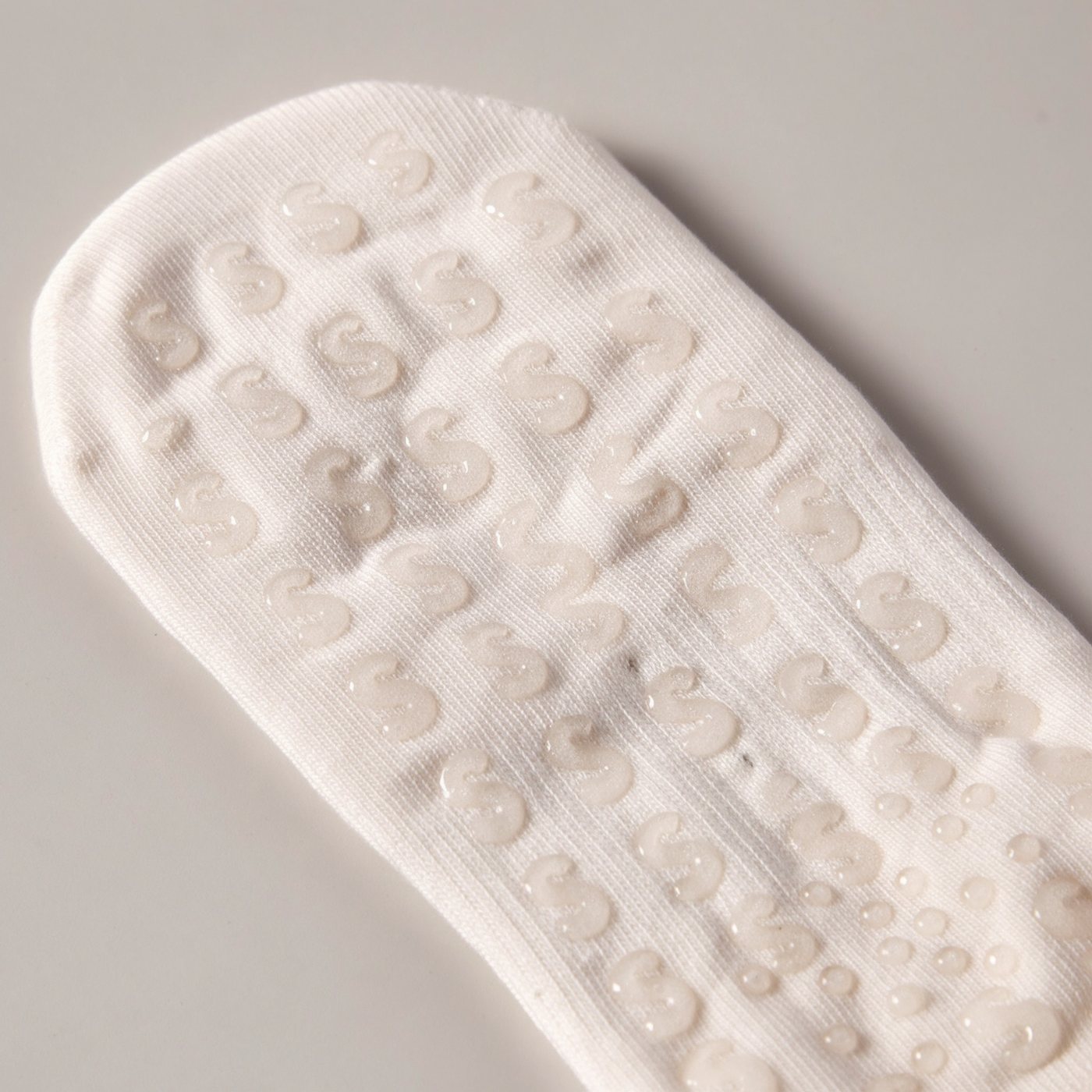
Our own socks use a high-density transparent PVC grip in an S-shaped layout on a cotton-rich blend, with a midfoot support structure and a raised heel tab. It is a combination designed for studio surfaces rather than for hiking or everyday wear, and it behaves best when it is kept for class.
Whichever pair you choose, give it a moment on the surface before class starts. A short roll of the foot from heel to toe tells you more about how the sole will behave than any description can.
Frequently asked questions
Do grip socks work on wooden floors?
They help. A dense grip sole gives noticeably more contact on smooth wood than bare feet or ordinary socks, though a polished or dusty floor will always be less predictable than a mat.
Are grip socks better than bare feet on a mat?
They suit different preferences. Bare feet give more feedback through the sole; grip socks add hygiene and a more consistent surface. Many studios ask for socks, which settles it in practice.
Why do my socks feel slippery on some days?
Moisture, floor polish and fabric softener all reduce grip. If the grip has faded across the whole sole rather than in one spot, it is usually time for a new pair.
Should I wear the same socks for reformer and barre?
Yes, if they fit well. A close-fitting ankle sock with a dense sole works across both. The exception is if you prefer a crew height for barre work in a cold studio.
How do I stop my socks sliding on the reformer footbar?
Check the heel first. A loose heel lets the foot rotate inside the sock. Then check placement — the ball of the foot, not the arch, is the contact point the bar is designed for.
Do I need a thicker sock for cold studios?
Thicker socks feel warmer but can dull feedback through the sole. A close-fitting crew sock is usually a better answer than a thicker sock in the same style.
Choosing for the surfaces you actually use
Most people do not need a different sock for every class. They need one pair that fits properly, a second pair for busy weeks, and a little awareness of what each surface asks of them. If your week is mostly reformer, start with an ankle style and a fitted heel. If it is mostly mat and yoga, a breathable yoga sock will feel better in a warm room. And if you are unsure of your size, the size guide is the quickest place to start.
