

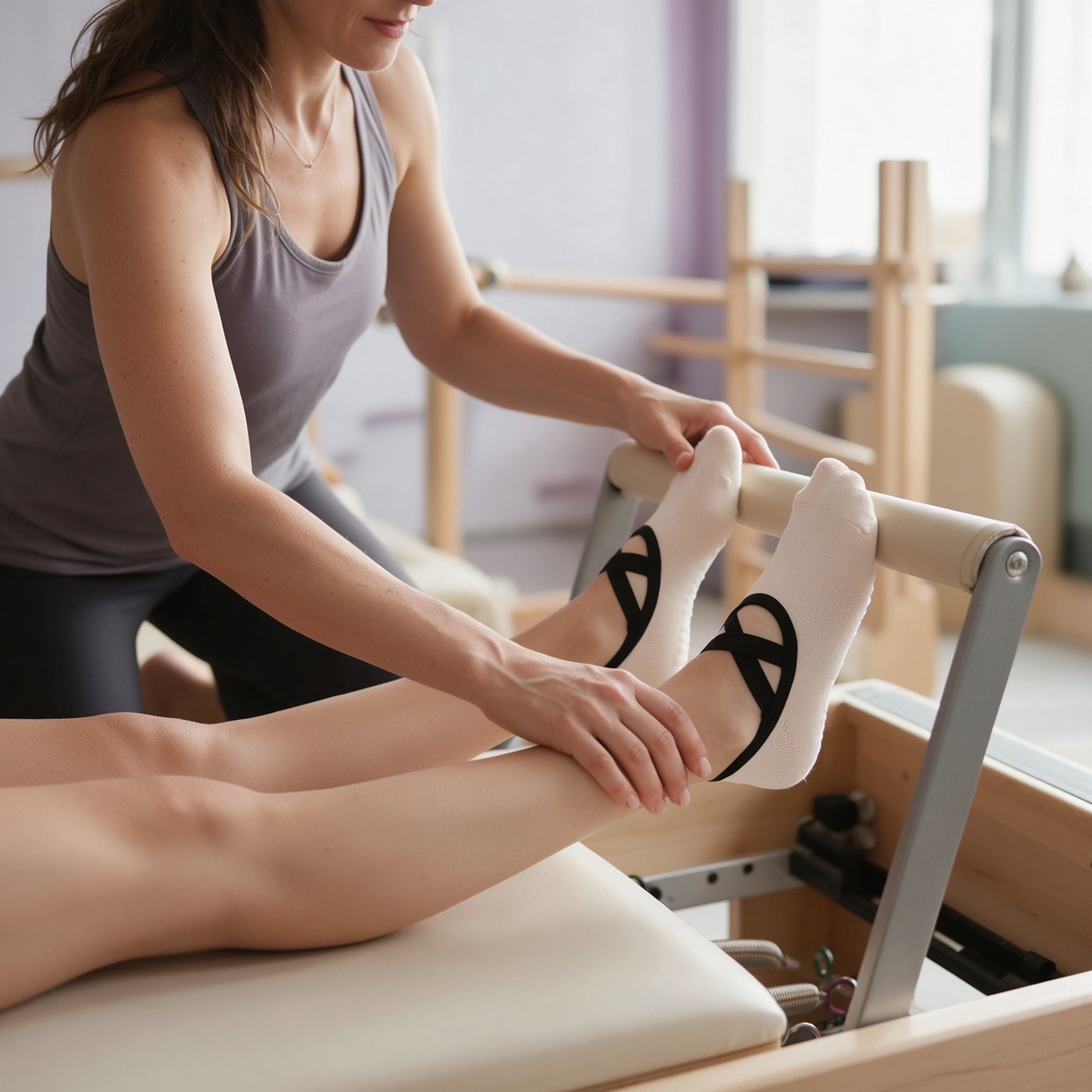
Teaching is a physical job disguised as a calm one. Four classes back to back means four hours on your feet, much of it on a hard floor, often in socks, often while talking. Instructors notice kit problems faster than anyone else because they live in it all day.
What the job asks of feet
Three things, mostly. Time standing, which accumulates quietly. Frequent transitions between demonstrating, spotting and walking around the room, which loads the foot in lots of small directions rather than one big one. And a floor that is rarely soft: wooden, tiled, or a mat that only covers part of the room.
Instructors also demonstrate far more than clients realise — a quick press here, a hip hinge there, twenty small movements in a class. Over a day, that adds up to a lot of contact with the floor in whatever you happen to be wearing.
How many pairs a day
Two pairs for a full teaching day is the practical minimum: one to teach in, one clean and dry for the afternoon. Instructors who teach four or more classes usually keep three in rotation, with one in the bag, one on and one drying.
The reason is not vanity. A sock worn through three classes is damp, which means it fits less closely by the third class and the grip is less reliable exactly when you are most tired. A dry pair is a small piece of self-care that also happens to be a professional standard.
Comfort on hard floors
Sole density matters differently for instructors than for clients. Clients want feedback for control; instructors want enough cushioning to survive a day of standing without losing the ability to feel the floor. A dense grip sole with a close knit is the reasonable middle.
Where instructors often go wrong is in choosing a very thick, plush sock for comfort. It feels lovely for the first class and vaguer by the third, and it takes longer to dry between sessions.
If you teach in a cold studio, a crew height is the more sensible choice than a thicker ankle sock: warmth at the ankle without changing the sole.

Looking professional without thinking about it
Instructors are visible in a way clients are not. Feet are on display for an hour, and a pair that has gone grey at the heel or lost its shape is noticeable. The simplest standard is a neutral palette — cream, oat, grey — that matches whatever you wear and does not draw attention.
Replace pairs when the sole softens rather than when they develop holes. The visible decline usually comes later than the functional one, and clients will notice neither if you replace on function.
Some studios ask instructors to wear the studio’s own retail range, which has the useful side effect of making the product visible in use. If you are setting that expectation, our studio page explains how instructor kit is usually handled.
The instructor’s kit bag
A small bag with three pairs, a spare hair tie, a cloth and a water bottle covers most days. Keep one pair in a separate pouch so clean and used socks never mix — it saves the small moment of uncertainty before the last class of the day.
It is also worth keeping a pair of ordinary socks in the bag. Walking out to the car in grip socks is the fastest way to wear out the sole, and it is a habit that creeps in when you are tired.
A teaching-day checklist
| Item | Why | Quantity |
|---|---|---|
| Grip socks, neutral colour | Professional, versatile, visible in use | 3 pairs |
| Separate pouch | Keeps clean and used pairs apart | 1 |
| Ordinary socks | For the walk to and from the car | 1 pair |
| Small cloth | Wipes equipment between classes | 1 |
| Water bottle | Talking all day is dehydrating | 1 |
Looking after the pairs you teach in
Wash cold, air dry, and skip fabric softener — the same rules as for clients, but with more urgency because your pairs are washed far more often. A rotation of three spreads the wear and keeps recovery time in the knit.
Our care guide sets out the method, and the ankle collection is the most common instructor choice. If you are building a kit bag from scratch, the studio essentials checklist puts the rest of the day into order.
Frequently asked questions
How many pairs of grip socks does an instructor need?
Three in rotation covers a full teaching day with a dry pair always available.
Should instructors wear padded socks?
Slight padding helps over a long day, but very thick soles reduce feedback and take longer to dry. Dense rather than plush is the better balance.
Is ankle or crew better for teaching?
Ankle for warm studios and frequent changes; crew for cold rooms and long days at the front desk.
Do instructors need to match the studio’s retail range?
Some studios ask for it so the product is visible in use. It is a policy decision rather than a product one.
How often should teaching pairs be replaced?
When the sole under the heel and ball softens, or the cuff stops springing back — often sooner than a client’s pair.
Can I teach in the same pair all day if I air them?
Air them and you can stretch to two classes, but a dry change at midday is worth it for fit and comfort.
Kit that supports the job
Teaching well is easier when nothing on your feet is asking for attention. Three pairs, a pouch, a neutral palette and a cold wash are a complete system — small enough to maintain, good enough to stand in all day.
