

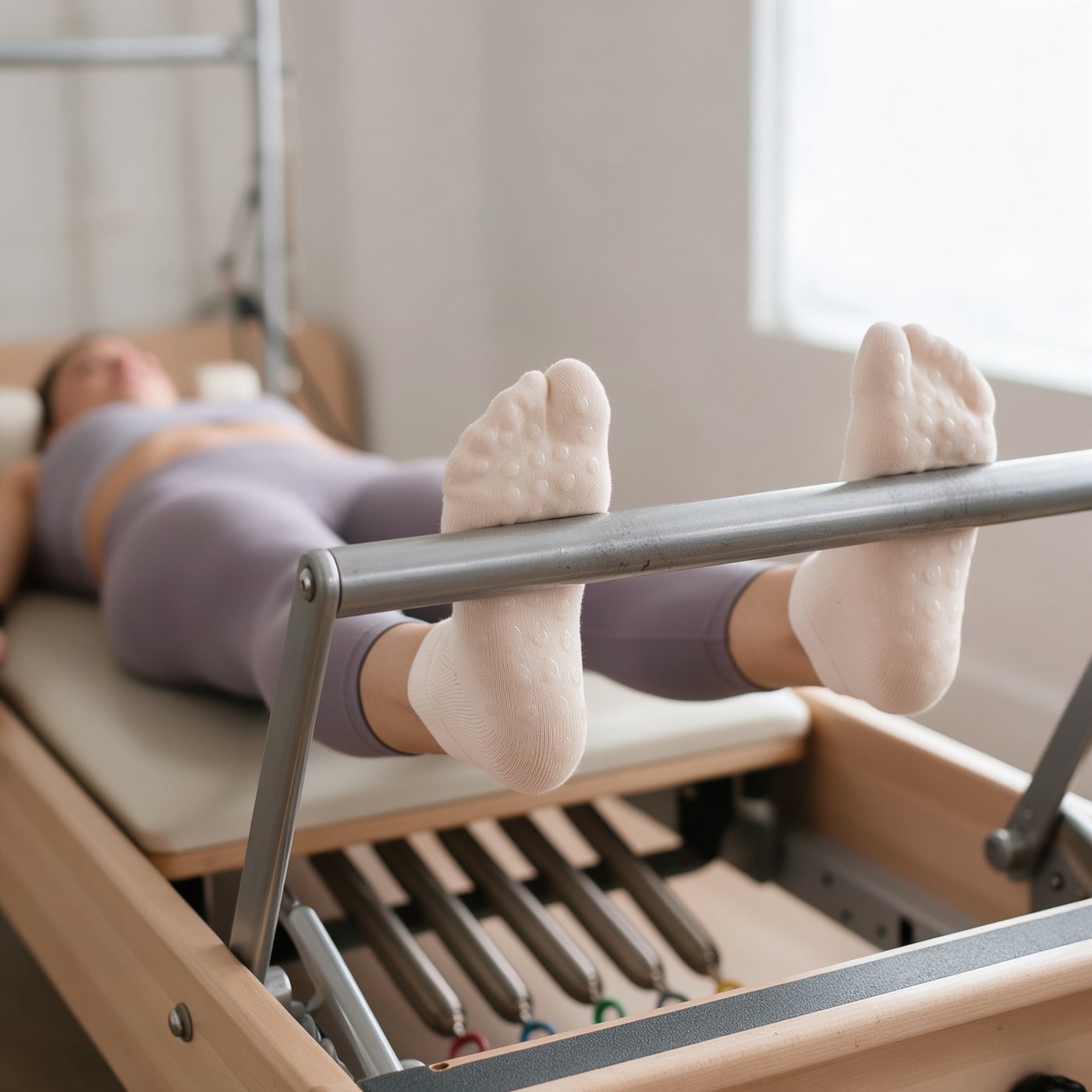
The footbar is the most direct conversation between you and the reformer. Every press travels from the ball of your foot through the ankle and up the leg. The jumpboard adds a landing. Both ask the sole to hold its position under load, and both expose details that are easy to ignore on a mat.
What the footbar asks of the foot
A footbar press is a small, loaded contact. The area of the foot in touch with the bar might be the size of a thumbnail, and the force going through it can be substantial, especially with heavier springs.
Two things keep that contact stable: the position of the foot on the bar and the fit of whatever is between the foot and the bar. A sock that fits closely keeps the sole aligned with the contact point. A sock that has slack at the heel lets the foot rotate underneath, and the grip pattern ends up where the foot no longer is.
Three placements, three loads
On the toes, the ball of the foot carries almost everything. This is the most demanding placement and the one where a dense sole is most noticeable. Keep the heel directly above the ball rather than dropping it, which changes the angle through the ankle.
On the arches, the contact spreads across the middle of the foot. It is more forgiving but easier to lose; if the arch rolls, the press becomes uneven. A sock with a midfoot support structure helps here by giving the foot something to hold against, rather than relying purely on muscular effort.
On the heels, the load moves to the back of the foot and the calf does more of the work. Grip matters less than alignment, but a fitted heel pocket is still the difference between a press that feels solid and one that feels slightly vague.

The jumpboard
The jumpboard turns footwork into something closer to plyometric work. You push off, land on the board, and absorb the return. Landing is where grip socks earn their place: the foot arrives with some force and needs to stay where it lands rather than skating up the board.
Technique still leads. A soft, quiet landing is the goal, with the knees tracking over the feet and the carriage returning under control. If you hear a thud on every landing, the issue is usually control rather than equipment.
Jumpboard work is also where shoe choice would be tempting and impractical. Grip socks give you a consistent sole without a shoe’s weight or thickness, which is why most studios ask for them.
Straps, handles and long holds
Foot straps in a long spine stretch or a semi-circle load the top of the foot rather than the sole. Grip is not the factor here; comfort and fit are. A sock that presses at the toe seam becomes very noticeable in a thirty-second hold.
Long holds also test cuff behaviour. A cuff that creeps during a hold is distracting, and it usually means the cuff is at the end of its life rather than the wrong size.
Where grip socks help
Three places, specifically. First, on the toes, where a dense, low sole gives a more predictable contact than bare skin on a padded bar. Second, on the jumpboard, where landing stability matters. Third, on a wooden floor between stations, where the walk from the reformer to the mat is where most accidental slips happen.
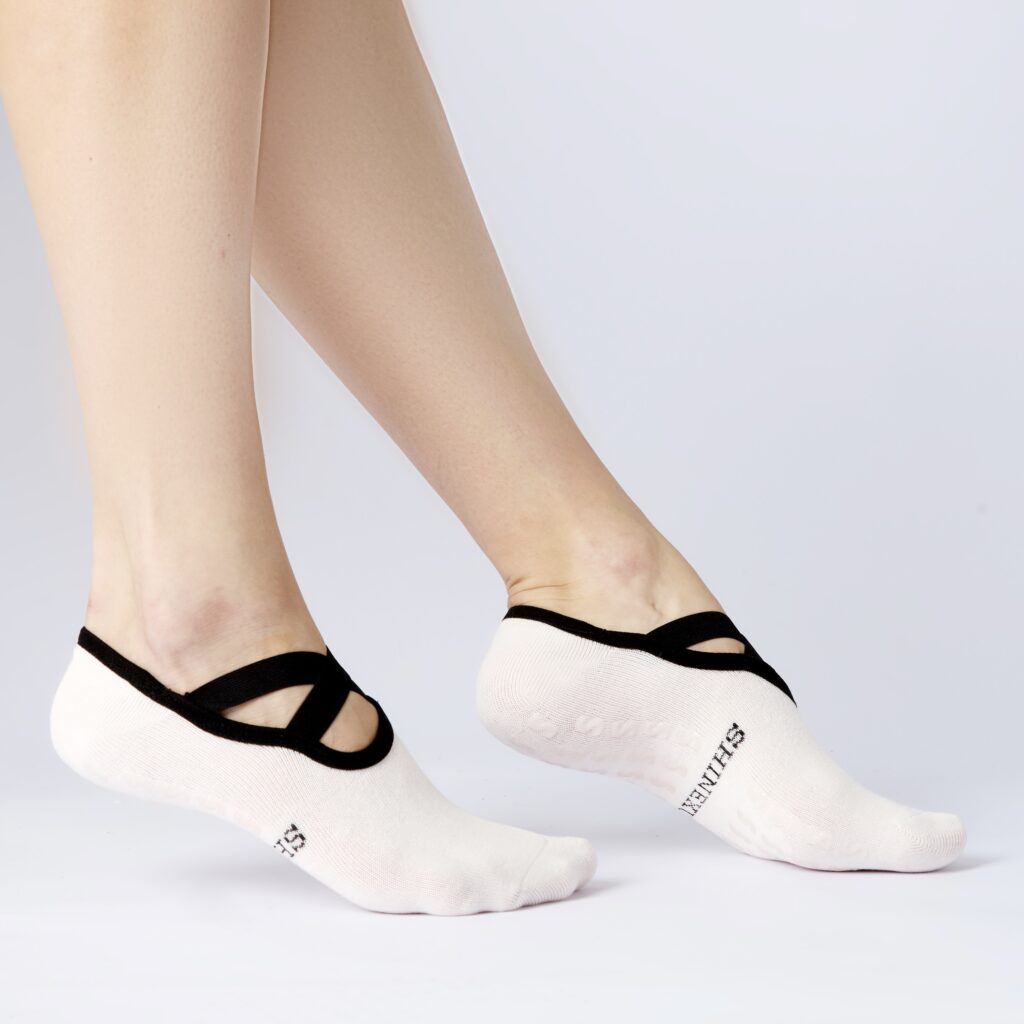
Our ankle grip socks are built with a fitted heel and a midfoot support structure for this kind of work. Our guide on whether you need grip socks for reformer covers the studio-policy question separately.
Where technique matters more
A collapsing arch, a foot placed too high on the bar, or springs that are too heavy for the movement will all produce the feeling that the foot is slipping, even when the sock is doing its job. The fix in those cases is coaching, not kit.
The same applies to ankle mobility. If the ankle cannot dorsiflex enough for a toes-on-bar press, the heel lifts and the contact narrows to a very small area. That is uncomfortable in any sock and worth addressing with your instructor.
If you are new to the equipment, the studio etiquette guide for reformer classes covers the practical expectations, from setting up springs to where to put your towel.
Load by position
| Placement | Contact area | What matters most |
|---|---|---|
| Toes on bar | Small, under the ball | Dense sole, fitted heel, ankle mobility |
| Arches on bar | Medium, midfoot | Midfoot support, no rolling |
| Heels on bar | Medium, back of foot | Alignment, heel pocket fit |
| Jumpboard landing | Whole sole, briefly | Control on landing, consistent grip |
Frequently asked questions
Do grip socks help with footbar work?
They help by keeping the sole aligned with a small contact point. Placement, springs and ankle mobility still matter more.
Are grip socks needed for the jumpboard?
Most studios ask for socks on equipment. On the jumpboard specifically, a sock that stays put makes landings feel more consistent.
Which foot placement is hardest on socks?
Toes on the bar. The contact is smallest and the pressure highest, so fit matters most there.
Why does my foot slip when I press?
Usually a loose heel, a foot placed too high on the bar, or an ankle that cannot dorsiflex enough. Check all three before changing socks.
Should I use a padded sock on the footbar?
Only if long holds feel uncomfortable. Padding softens feedback, which some people dislike in fast footwork.
Can I wear grip socks with foot straps?
Yes. Straps load the top of the foot, so the priority is a flat toe seam and a cuff that does not creep.
Small contact, precise details
Reformer footwork rewards precision. A sock that stays where it is put, a foot placed deliberately and springs chosen for the movement will do more for your press than any upgrade. Grip is the quiet part of that equation, and the part that is easiest to get right.
